She Has 271,587 Miles Left

Today, my wife said goodbye to her 2015 Honda Pilot.

It was not an attractive car (particularly as of late), but it had lived a full life. By the time we handed over the keys, the odometer read 271,587 miles.

I found myself thinking about the bracha one says when purchasing a new car. Sometimes the appropriate bracha is shehecheyanu. But when the benefit is shared with others, the bracha is Hatov VeHaMeitiv, thanking Hashem not only for what we have received but also for the good that others will receive through it.

That bracha subtly asks us to think not only about what we have acquired, but about what it may allow us to give. When we receive something new, what do we imagine it is for? Is it mainly for our own comfort, our own convenience, our own plans? Or do we see it as something that can help us show up for other people?

Chaviva’s Honda Pilot did a lot of showing up. It carried people to appointments and smachot, to airports and hospitals, to homes where a visit was needed and places where a favor could not wait. A challah dropped off before Shabbos. A ride that could not wait for someone else to offer it. I can picture my wife pulling up outside someone’s house countless times, not making much of it, just doing what had to be done. Another ride. Another errand. Another small act of care that would never be counted anywhere.

Except, of course, it would be counted. Not by her. Not on the dashboard. But in the quiet accounting of a life lived with purpose, those things matter.

I once heard my dear friend, Rabbi Avraham Willig, recount something his late mother-in-law, Rebbetzin Henny Machlis z”l, would ask her children and grandchildren. “If I have ten dollars in my pocket,” she would say, “and someone comes to the door asking for tzedakah, and I give him two dollars, how much do I have left?”

“Eight,” they would answer.

She would ask again.

“Are you sure? I had ten dollars, and I gave away two. How much do I have left?”

Again, they would say, “Eight.”

“No,” she would tell them gently. “You have two.”

She would then explain that the eight dollars still in your pocket may or may not remain yours in any lasting way. You may spend them wisely, or you may not. You may lose them. They may pass through your hands and leave no real trace. But the two dollars you gave to another person are yours forever. No one can take them away. They have already become part of you.

Perhaps that is what an odometer cannot measure. The miles we drive for ourselves fade into the past. But the miles spent carrying someone else to a doctor’s appointment, to a hospital, to a simcha, or simply to where they needed to be, those miles we keep.

The Torah does not ask us to reject the material blessings we are given. A car, a home, a livelihood. These are ordinary things. But in the hands of someone who wants to do good, ordinary things become instruments of chesed.

That is what made saying goodbye to this car feel unexpectedly meaningful. It was only metal and rubber, coffee stains and worn seats. But for many years, it helped carry something sacred.

Cars wear out. Engines fail. Paint fades. Odometers stop counting. But every act of kindness leaves behind something that does not depreciate.

Her 2015 Honda Pilot has spent 271,587 miles. Every last one of them well.

My wife? She still has 271,587 miles left.

A Lifetime in Twenty Feet: What to Leave and What to Bring

Twenty feet sounds like a lot until it has to hold a lifetime.

In just a few days, the movers will come to pack our belongings into a twenty-foot container that will carry them across the ocean. Furniture, clothing, sefarim, family memories, and the accumulated evidence of years lived in one place. Somehow, all of it has to be measured, sorted, chosen, and packed. We are not only deciding what to ship. We are deciding which parts of our lives we want to carry forward.

For most of Jewish history, when Jews moved, they did not have months to plan, lists to organize, or containers to ship across an ocean. They often had hours. Sometimes less. What they could carry fit into a wagon, or more likely into a small bundle over their shoulders. They carried whatever they could, and they carried what they had to. So I feel grateful beyond words for the luxury of this kind of decision. It is overwhelming, but it is also a gift.

As the boxes fill, I find myself thinking less about furniture and more about identity. Less about possessions and more about values. Less about what will fit into a container and more about what belongs in the life I am trying to build.

The Gemara in Pesachim (87b) teaches that one of the purposes of galus was to gather converts, souls drawn to the Jewish people through our presence among the nations. Later thinkers expanded this idea further, understanding galus as an opportunity to gather ניצוצות הקדושה, sparks of holiness, from the many places we passed through. That means galus was never only displacement. It was also a mission.  So, aliyah, at least for me in this moment, does not feel simply like leaving. It feels like returning with what has been gathered.  And that means I have to ask myself honestly what parts of galus I am ready to leave behind, and which sparks I hope to bring home.

The first thing I hope to leave behind is a survivor mentality.  Indeed, survival is sacred, and we should never speak lightly of it. For much of our history, survival itself was a form of avodas Hashem. To endure, to remain faithful, to raise Jewish children, to hold onto Torah under conditions of pressure and uncertainty, these were not small things. They preserved us.

But survival, for all its dignity, was never meant to be the final goal of Jewish life. We were not created only to live another day. We were created to build, to plant, to create, and to take responsibility for the future.  I am grateful to be moving toward a life that feels less like holding on and more like planting. Less like preserving a fragile presence and more like helping build something meant to last, a בנין של קיימא.

The second thing I hope to leave behind is the feeling of being a stranger.  I say this with deep gratitude. I am proud to be an American. As this country approaches its 250th anniversary, I believe the United States has been an extraordinary blessing to the Jewish people. For generations, it offered safety, opportunity, freedom, and dignity. That gratitude is real and should never be minimized.

And yet, even with all of that, I have carried a feeling, sometimes subtle and sometimes less so, that I am still a guest. Avraham Avinu described himself as both a ger and a toshav, a stranger and a resident. That has often felt to me like the paradox of Jewish life in exile. We build homes, institutions, friendships, and communities. We contribute to the broader society with loyalty and appreciation. And still, some part of us may know that our deepest story is elsewhere.

I am looking forward to living more fully as a toshav. Not because life in Eretz Yisrael is simple, and not because it erases every tension, but because Jewish identity there is not an accommodation. It is the language of the street, the rhythm of the calendar, and the fabric of the culture. I am looking forward to a life in which our story is not peripheral, but central.

The third thing I am grateful to leave behind is the question itself.  For many years, I lived with the question of aliyah. Anyone who has considered it honestly knows that the decision touches nearly every part of life. It is not romantic. It is not simple. It is not made only in the language of ideals. It is made through conversations, anxieties, hopes, practical details, and many long pauses.

Over the past number of months, people have said to me, “It is amazing what you have done.” My response has consistently been that I have, in fact, not done anything. I am still here. (The boxes are not even gone.)  But in truth, something has happened. A decision has been made. That does not mean I have certainty. It does not mean I know what will unfold. But there is a quiet gift in having crossed from wondering into commitment.

So, those are some of the things I hope to leave behind: the instinct to survive instead of build, the feeling of being a stranger, and the long uncertainty of the decision itself.  But aliyah is not only about leaving. It is also about carrying. And there are gifts from chutz la’aretz that I very much hope to bring with me.

The first gift I hope to bring is the accumulation of what galus has taught me, what Rav Shlomo Wolbe z”l, in the sefer עלי שור, calls התלמדות, the practice of allowing oneself to be shaped by experience. It is not the same as studying a subject or mastering a skill. It is something quieter, the readiness to be changed by what life places in front of you, to treat every encounter, every success, and every setback as something that has come to teach. Not every experience announces its lesson. Some lessons come gently. Some we understand only years later. But a person who moves through life with that willingness does not leave empty-handed, even from the hardest stretches.

So when I think about what I am packing, I am not thinking only of pictures or possessions. I am thinking about a congregant who taught me more about emunah during her illness than I ever taught her. About a mentor who corrected me in a way that stung for a week and shaped me for years. About hundreds of Shabbos tables, thousands of difficult conversations, and countless interactions, that I can still feel. These are not items in a container, but they are very much coming with me.

The second is a community mindset.  There is something remarkable about American Orthodoxy. We have built strong shuls, schools, institutions, chesed networks, and communities of real responsibility. I think many of us take this for granted. We assume that Jewish life naturally organizes itself around a shul that is more than a place to daven, a school that is more than a place of instruction, and a community that is more than a collection of households. But none of that is automatic.

I have watched families sit together in a shul lobby after a loss and felt the room hold them. I have seen communities mobilize overnight because someone needed help. A tzibbur is not just ten people gathered in the same room. A kehilla, at its best, becomes a place where people carry one another in joy, in sorrow, in growth, and in responsibility.  That is something I hope to bring with me. The conviction that Jewish life flourishes when it is rooted in relationship, that Torah and tefillah need the warmth of human connection. A kehilla can become a home.

The third gift I hope to bring is the spirit of being metzapeh l’yeshuah, continuing to yearn for redemption.  One of the gifts of galus is that it keeps us aware that history is not yet complete. We know, almost instinctively, that we have not arrived. So much of Shemoneh Esrei is a plea for national restoration, for Yerushalayim, for Malchus Beis David, and for the rebuilding of what remains broken.  Aliyah is, on a personal level, a step closer. A movement toward home. But it is not the completion of the story. Even in Eretz Yisrael, we still daven for geulah. We still say, “כי לישועתך קיוינו כל היום.” We still live with longing.

I do not want to lose that. I do not want arrival to dull the ache for what remains unfinished. Being metzapeh l’yeshuah is not only about waiting. It is to live with the awareness that the world is not yet what it is meant to be, and that our own small acts of building, planting, learning, and returning are part of something much larger than ourselves.

And so, as I prepare for this move, I have learned something simple and profound. Not everything fits.  That is true of containers, and it is true of life. Every major transition forces us to decide what belongs in the future and what belongs in the past. Marriage, parenthood, career change, loss, renewal, and aliyah each ask their own version of the same question. What am I carrying that still belongs with me? What am I holding that should finally be left behind?

As I stand just days before this next chapter, I hope to leave behind whatever narrows the soul and carry forward whatever has deepened it. I hope to leave behind the habits that no longer serve the future and bring home the holiness that galus, in its complicated way, allowed us to gather.

In Israel, storage space is significantly limited, and quite simply, not everything fits. And maybe that is the way it is supposed to be. When packing an entire life into a twenty-foot container, one is forced to ask: what must be packed, what should be released, and what sparks are we meant to carry home.

The Torah’s Definition of Real Conversation

We should stop pretending that convenience has helped us become better communicators. It hasn’t.

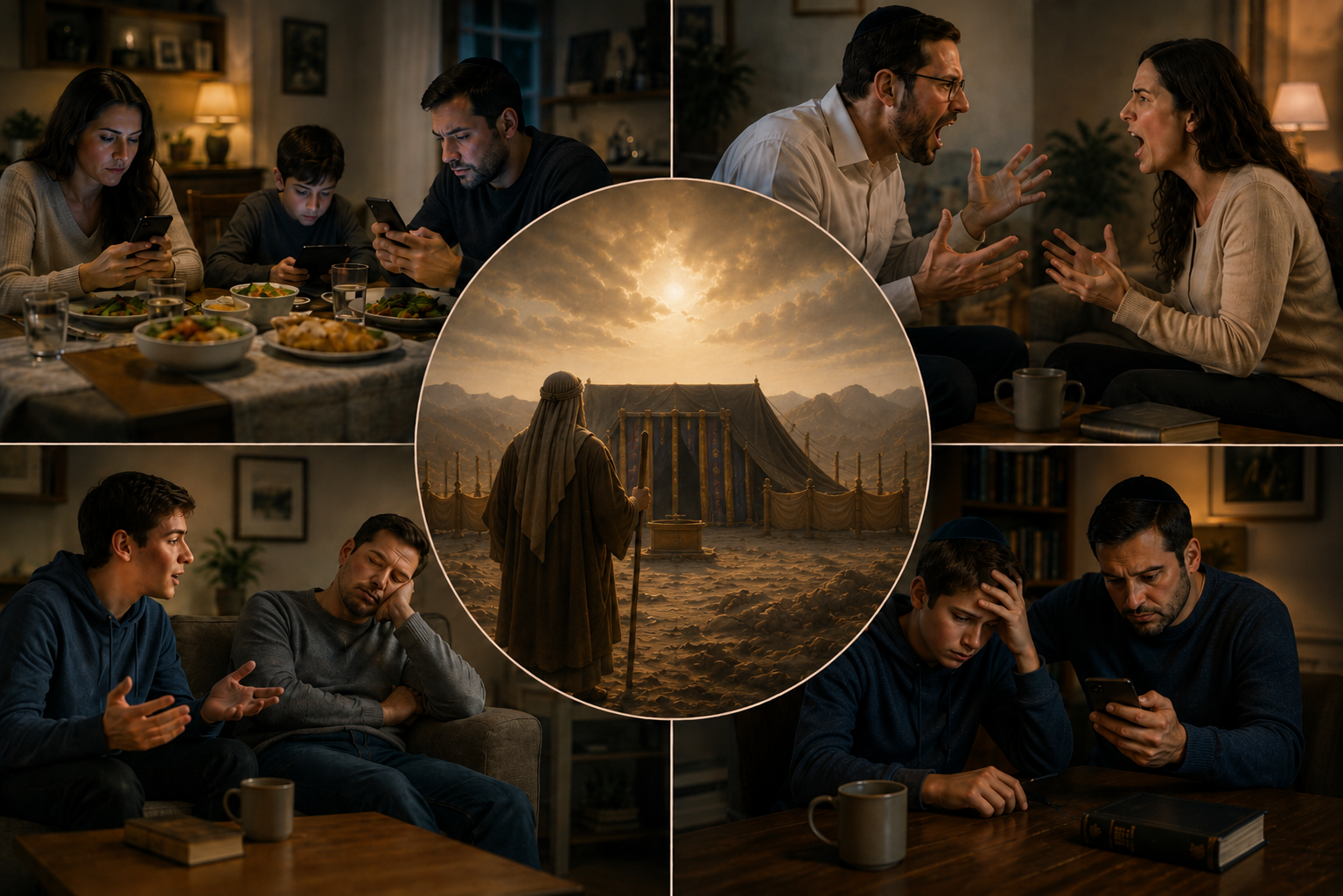
It has allowed us to respond faster. It has made us easier to reach. But it has not nurtured honesty, attentiveness, or presence. If anything, it has given our worst habits more room to grow. We apologize through screens. We argue through fragments. We comfort people while multitasking. We answer those closest to us with one eye on whatever else is glowing in our hands.

The Torah provides a very specific standard when it describes Moshe Rabbeinu’s prophetic experience: ודבר ה׳ אל משה פנים אל פנים כאשר ידבר איש אל רעהו, “Hashem would speak to Moshe face to face, as a man speaks with his friend.” That final phrase is not only describing Moshe’s prophecy. It is telling us, clearly and unambiguously, what real human conversation is supposed to look like: present, direct, attentive, and face-to-face.

The Rambam (הלכות יסודי התורה פרק ז) gives us a way to understand that model more deeply. Here, the Rambam affirms the unique level of Moshe Rabbeinu’s prophecy, a level that was never equaled before him and will never be equaled after him. What is striking, though, is how much attention the Rambam gives this principle. Other principles are presented with relative brevity. The Rambam affirms the oneness of Hashem, for example, without elaborating on all of its depth and implications. But when he discusses Moshe Rabbeinu’s prophecy, he explains it in detail. He lists four distinct ways in which Moshe’s prophetic experience differed from that of every other prophet.

The Rambam clearly intends to demonstrate not only that Moshe Rabbeinu’s prophecy was different, but how it was different. And when we look carefully at those four distinctions, two of which are found in this week’s parsha, they do not remain confined to the world of prophecy. They begin to form a model of communication that instructs us how to become better communicators.

1. Moshe Rabbeinu’s prophecy was direct.

All other prophets received prophecy through the medium of an angel. Moshe Rabbeinu did not. Hashem communicated with him directly. The Rambam’s proof is from this week’s parsha: פה אל פה אדבר בו ומראה ולא בחידת, “Mouth to mouth I speak with him, in a clear vision and not in riddles.”

So much of our communication today is conducted in riddles. Not because we are especially deep, but because we are often unwilling to be clear. We hint. We imply. We delay. We send messages whose real meaning sits somewhere beneath the words, waiting for the other person to figure it out. Sometimes we do this because we are trying to be sensitive. But often, if we are honest, we do it because we are afraid. We do not want to have the difficult conversation. We do not want to say what needs to be said. We do not want the discomfort of being direct.

There is a reason we hide. Direct speech can be risky. Once words are spoken clearly, we can no longer pretend we were misunderstood. We can no longer retreat into ambiguity. We expose what we think, what we feel, and what we need, and sometimes that is frightening. So we hide behind half sentences, vague texts, carefully placed silences, or the small emotional theater of punctuation and emojis.

There are times when written communication is useful, even necessary. But there are also times when a conversation deserves a human face. An apology should often be given with eyes that show regret. A painful concern should be expressed in a voice that carries care. A serious conversation should not be reduced to a rushed message sent between errands.

Moshe Rabbeinu’s prophecy was פה אל פה, direct, clear, without riddles. Again, we are not prophets, and we are not comparing ordinary human speech to nevuah. But the Torah’s language still teaches us something. Real communication requires courage. It requires the willingness to be understood. It requires us to stop hiding from the people we claim to care about.

2. Moshe Rabbeinu received prophecy while fully awake.

All other prophets experienced prophecy in sleep or in an altered state. Moshe Rabbeinu received prophecy while awake, alert, and in control of his senses. The Rambam cites the pasuk: ונועדתי לך שם ודברתי אתך מעל הכפרת, “I will meet with you there, and I will speak with you from above the [Ark’s] cover.”  Moshe was awake. Present. Fully there.  That, too, is a standard we need to recover.

There is something painful about speaking to someone who is only half-listening. Their body is in the room. They may even nod at the right times. But their eyes drift downward. Their fingers keep moving. And somewhere inside, the speaker understands: I do not really have this person. Most of us have felt that. Most of us have done it to someone else.

A child comes home with a story, and the parent answers while checking a message. A spouse shares something important, and the other spouse responds while scanning an email. A friend begins to open up, and the listener glances at the phone for just a second, but that second says more than we realize. People can feel when we are not fully with them.

Here too, the failure is understandable. We are tired. We are distracted. We are carrying more than people can see. Sometimes the phone is not merely entertainment; it is an escape. But that is precisely why presence matters. As much as possible, we should make it our business not to look at our phones when someone is speaking to us. Not because phones are evil. They are not. But because attention is one of the simplest ways we show another person that they matter. To listen well is to give a person the dignity of our presence. It means turning toward them. Letting our eyes rest where the relationship is. Not preparing our answer before they finish speaking. Not treating their words as background noise to whatever else is occupying our minds.

3. Moshe Rabbeinu was not overwhelmed by prophecy.

All other prophets were overwhelmed by prophecy. The experience frightened them, weakened them, and left them feeling as though they were on the verge of death. Moshe Rabbeinu was different. He was not overwhelmed by his prophetic experience. The pasuk says: ודבר ה׳ אל משה פנים אל פנים כאשר ידבר איש אל רעהו, “Hashem would speak to Moshe face to face, as a man speaks with his friend.” Moshe Rabbeinu could receive the word of Hashem without collapsing. There is a human version of that strength. It is the ability to listen without immediately reacting.

Many of us struggle with this. Someone criticizes us, and we become defensive before they finish the sentence. Someone shares pain, and we rush to fix it because their sadness makes us uncomfortable. Someone says something we disagree with, and we respond with intensity before we have taken the time to understand what they actually meant. Sometimes our reaction is so loud that the other person’s message never really arrives.

And this, too, is not because we are bad people. Often, it is because listening well makes us vulnerable. If I really hear your criticism, I may have to change. If I really hear your pain, I may have to sit with my helplessness. If I really hear your perspective, I may have to surrender the satisfying simplicity of my own. So we interrupt. We explain. We defend. We advise. We take control of the conversation because receiving it honestly feels too exposed.

This can be especially damaging when people turn to us for advice. If we react too quickly, too sharply, or too emotionally, we may think we are helping. But we may actually be making it harder for them to speak honestly. They begin to protect us from their words. They soften what they need to say. They stop telling the truth because they do not want to manage our response. And then we cannot help them properly. We cannot offer sound, objective advice if we have not first absorbed what they are trying to say.

To listen well requires inner steadiness. Not coldness nor indifference, but steadiness. The capacity to hear something painful, complicated, or unexpected without taking control of the conversation too quickly. Sometimes a person does not need our immediate judgment. They need our patience. They need room to finish the sentence. They need to know that we can hold what they are saying without becoming overwhelmed by it.

Moshe Rabbeinu stood before the word of Hashem and remained fully himself. On our much smaller level, we are asked to stand before another person’s words without falling apart.

Clarity allows a conversation to begin. Presence allows it to be received. Steadiness allows it to deepen. But the final distinction adds one more demand. Real communication is not only about how we respond when someone speaks to us. Sometimes it is about whether we are willing to step forward at all.

4. Moshe Rabbeinu could initiate prophecy.

No other prophet could initiate prophecy. A prophet could receive the word of Hashem only when Hashem chose to communicate with him. Moshe Rabbeinu, however, could initiate prophecy whenever necessary. Here too, the Rambam cites a pasuk from this week’s parsha: עמדו ואשמעה מה יצוה ה׳ לכם, “Stand, and I will hear what Hashem will command you.”

Moshe was always available. He was always on call. That reflects his singular role as the leader and teacher of Klal Yisrael. But it also reminds us that responsibility requires availability. Each of us has people toward whom we carry obligations: a spouse, children, parents, friends, students, and colleagues. People who rely on us not only for affection, but for steadiness and dependability.

Availability does not mean we have no boundaries. It does not mean we must answer every call immediately or live in a state of constant interruption. But it does mean that we cannot arrange our lives entirely around convenience and then call ourselves responsible. People should know that we can be counted on. They need to know that when something matters, we will not disappear into busyness, avoidance, or delay.

And availability means something else as well. Sometimes we have to initiate the conversation. There are conversations that will not begin unless someone has the courage to begin them. An apology that has waited too long. A concern about a child. A friendship that has become strained. A family issue everyone feels, but no one wants to name.  It is easy to wait. We tell ourselves that perhaps the problem will fade. Perhaps the other person will bring it up. Perhaps silence is kinder. But sometimes silence is not kindness. Sometimes it is fear.

Moshe Rabbeinu could say, עמדו ואשמעה, “Stand, and I will hear.” He did not always wait passively. When Klal Yisrael needed guidance, he stepped forward and sought the word of Hashem. Again, we are not Moshe Rabbeinu. But there are moments when responsibility means taking the initiative. Gently, carefully, without accusation, but clearly.

The Rambam’s seventh principle is, first and foremost, a foundation of emunah. We believe that Moshe Rabbeinu’s prophecy was utterly unique. Through him, the Torah was given with perfect clarity and absolute authority. But Torah is never merely abstract. Even its highest principles are meant to shape the way we live in our kitchens, in our cars, at our Shabbos tables, in our marriages, in our friendships, and in the small conversations that determine the quality of our relationships.

Moshe Rabbeinu’s prophecy teaches us what communication looks like at its highest point: direct, awake, steady, and available. Our conversations are not prophetic. But they can still carry a trace of that dignity.

The Torah describes Hashem speaking to Moshe כאשר ידבר איש אל רעהו, “as a man speaks with his friend.” That is a remarkable phrase. It means that human speech, at its best, is not casual or cheap. It is one of the ways we honor the image of God in another person.

And perhaps, in a world filled with so much noise and so little true listening, that itself would be a beginning, not of prophecy, but of becoming more deeply human.

After Sinai: The Torah of Plan B

There are moments in history that change everything. And then there are moments so foundational, so transcendent, that it seems all of history was waiting for them.

Ma’amad Har Sinai was such a moment. Chazal teach us that the world itself was created for Torah, Bereishis, for the sake of reishis, for the sake of Torah, which is called reishis. Everything before Sinai seems, in some way, to have been moving toward that single point: Adam and Chava, Avraham and Sarah, Yitzchak and Rivka, Yaakov and his family, the descent to Mitzrayim, the suffering, the redemption, the crossing of the sea. All of it was a long, sacred prelude to the moment when the infinite voice of Hashem entered human history and became Torah.

And then, almost immediately, everything shattered. Before the echoes of revelation had even faded, before the awe of Sinai could settle into the life of the people, came the Eigel HaZahav, the golden calf. It was a staggering, almost unimaginable collapse. Moshe came down from the mountain holding the Luchos, carved and written by Hashem Himself, and broke them.

It is difficult to absorb the shock of that moment. The world had waited thousands of years for Sinai. Creation itself, Chazal tell us, was suspended in anticipation. Yet the first expression of that Torah, the first Luchos, did not remain whole. How does something so full of promise break so quickly?

At first glance, it feels like an exception, a tragic interruption in an otherwise orderly story. But look closer, and it becomes clear that this is no exception at all. The Torah prepares us for this from the very beginning, presenting moment after moment filled with promise that does not unfold as expected. Gan Eden begins as paradise, only for humanity to be exiled. Noach emerges into a renewed world, only to find that human frailty survived the flood. Avraham is promised a future but waits decades in a landscape of uncertainty. Yaakov receives the blessing, but his life is defined by flight, deception, grief, and struggle. Yosef dreams of greatness, but his path runs through a pit, slavery, false accusation, and prison. These stories aren’t incidental; they form a sacred pattern. The Torah is not a book about life going smoothly the first time. It is a record of human beings encountering disappointment, confusion, failure, and loss, and then being asked to keep walking.

Still, the breaking of the Luchos stands apart. It isn’t just another example of Plan A giving way to Plan B; it becomes the central image through which the Torah teaches us how to live with what remains after a rupture. The Gemara teaches that both the second Luchos and the broken pieces of the first Luchos were kept in the Aron. At the very center of Jewish holiness, in the Kodesh HaKodashim, there was room not only for what remained whole, but also for what had shattered.

Think about that image for a moment. The broken pieces were not buried. They were not hidden away in shame or treated as remnants of a failed beginning that needed to be forgotten. They were placed in the Aron, right alongside the whole Luchos, in the holiest place on earth. This means holiness does not require the erasure of brokenness, but rather its sanctification. The Aron did not just hold the ideal; it held the whole story. It held the original dream and its shattered remains. It held what came directly from heaven and what had to be rebuilt through human sweat. It held the Torah of innocence and the Torah of repair.

This may be one of the most compassionate teachings Chazal offer us. We often imagine holiness as synonymous with wholeness, assuming that what is broken must first be fixed before it can belong in a sacred space. But the Aron teaches otherwise. Some broken things are not removed from kedusha; they are carried directly into its center.

There is a Torah of the first Luchos, pure, pristine, untouched by failure. But there is also a Torah of the second Luchos, received after sin, after pleading, after Moshe returns to the mountain, and after the people learn that their relationship with Hashem can survive devastation.

The second Luchos were fundamentally different. The first were carved and written by Hashem. The second were carved by Moshe at Hashem’s command. Human hands now had a role in preparing the tablets. What had once been received entirely from above now required the active participation of man.

The Ibn Ezra, in Parashas Yisro, cites a tradition from the Gaon that identifies seven ways in which the second Luchos were actually greater than the first. Whether one accepts that specific conclusion or not, the very possibility is striking. It suggests that the Torah coming after a breaking is not merely a diminished version of what came before. It carries its own depth, its own dignity, its own revelation. The Beis HaLevi deepens this idea further, teaching that the second Luchos mark the beginning of Torah Sheba’al Peh, the Oral Torah, the Torah that unfolds through human struggle, questioning, interpretation, and transmission.

Where the first Luchos represent a Torah descending from heaven in perfect form, the second Luchos introduce a Torah that must be carried, worked through, clarified, debated, and lived. They open the door to a different kind of relationship with Hashem’s word, not less Divine, but more deeply internalized through human effort.

Torah Sheba’al Peh is born not in the untouched perfection of the first moment, but in the aftermath of the break. That doesn’t make the breaking good; it makes the repair sacred.

Perhaps this is why the broken Luchos remain in the Aron. They testify that the Torah we live by is not only the Torah of revelation, but also the Torah of return. It is not just the Torah of what Hashem gives, but the Torah of what we struggle to receive, lose, seek again, and rebuild within ourselves.

This isn’t just a national teaching; it is a deeply personal one. Our lives rarely unfold the way we imagined they would. We all carry a quiet script inside us, sometimes written in childhood, sometimes shaped by community, longing, or fear. We imagine how life is supposed to look, the order in which things should happen, and the ease with which certain blessings should arrive.

And then life happens. A marriage does not come. A child struggles. Health changes. A dream collapses, a relationship breaks, or a plan we counted on no longer makes sense. Sometimes the shift is dramatic and public; sometimes it is private, almost invisible to others. But inside, the same sentence rises: “This is not the way it was supposed to be.”

That sentiment deserves compassion. It is not wrong to feel it. Pain is not a lack of faith, and disappointment is not a spiritual failure. There are times when the most honest tefillah a person can offer is simply, “Hashem, please make this stop. I cannot carry this anymore.”

But once we honor that pain, we may have to ask a deeper question: Who told us what “supposed to be” means? Who gave us the script? Perhaps what we call Plan B is not a departure from the plan at all. Perhaps, sometimes, it is the exact place where Hashem is writing the script with us in real time.

This doesn’t mean pain is easy, or that every loss can be neatly understood. It certainly doesn’t mean we should rush to explain away another person’s suffering. There are wounds that cannot be resolved by a thought, even a true one. There are chapters in life where perspective comes only later, and sometimes, not at all in this world. But the Aron teaches us that brokenness is not outside the story of kedusha. Sometimes, it is the very thing carried into its holiest place.

There is a fascinating Medrash that tells us that before Hashem created this world, He created worlds and destroyed them. It is a mysterious teaching, and I do not pretend to fully understand it. Why would Hashem create worlds only to destroy them? Why allow earlier worlds to disappear before letting this one endure?

Rav Soloveitchik zt”l addressed this Medrash in his 1957 Yahrzeit Shiur. He opened by describing the Midrash itself, then turned to its lesson for anyone who has lost a world and must build again:

A Jew has to know how to emulate God, and, like God, to continue to create even after his former world has been eradicated. True, what I have in Boston may not be as beautiful as the European Torah world before the Holocaust. Nevertheless, it is the world we now have. We have to continue to build it and not look back. We must not be cynical, and we should direct our attention and efforts to the future. We must look ahead.

We are not always given back what we lost. But we are still asked to build. Not because the new world is the same, and not because the pain has disappeared, but because this is the world we have right now, and there is *avodah to be done here, too.

It is much easier to remain attached to the world we thought we were going to inhabit, the life we thought we would have, the family we envisioned, the body that used to work differently, the opportunities that seemed certain and then vanished.

There is a time to grieve those losses; that grief is necessary and holy. But there is also a time, if we are able, to say: This is where I am now. This is the life in front of me. I did not choose all of it. I may not understand much of it. But I am still here, and there is still something Hashem is asking of me here.

Shavuos is the Yom Tov of revelation, of clarity, of Hashem’s voice filling the world. It is the day we return to Sinai and recommit ourselves to Torah. But the story of the Torah we actually live does not remain suspended in the thunder and lightning. It moves through the breaking. It includes Moshe climbing the mountain a second time. It includes the second Luchos. It includes Torah Sheba’al Peh, the Torah that demands human effort, patience, struggle, and rebuilding.

That is the Torah we carry. We carry what is whole, and we carry what is broken. We do not always get to choose what enters the Aron of our lives. But with Hashem’s help, we can learn to hold it all with faith.

Plan B is rarely the life we imagined. But sometimes, in ways we could never have planned, it becomes the exact place where our deepest Torah begins.