
Aliyah, the Old Wooden Roller Coaster, and the Limits of Persuasion

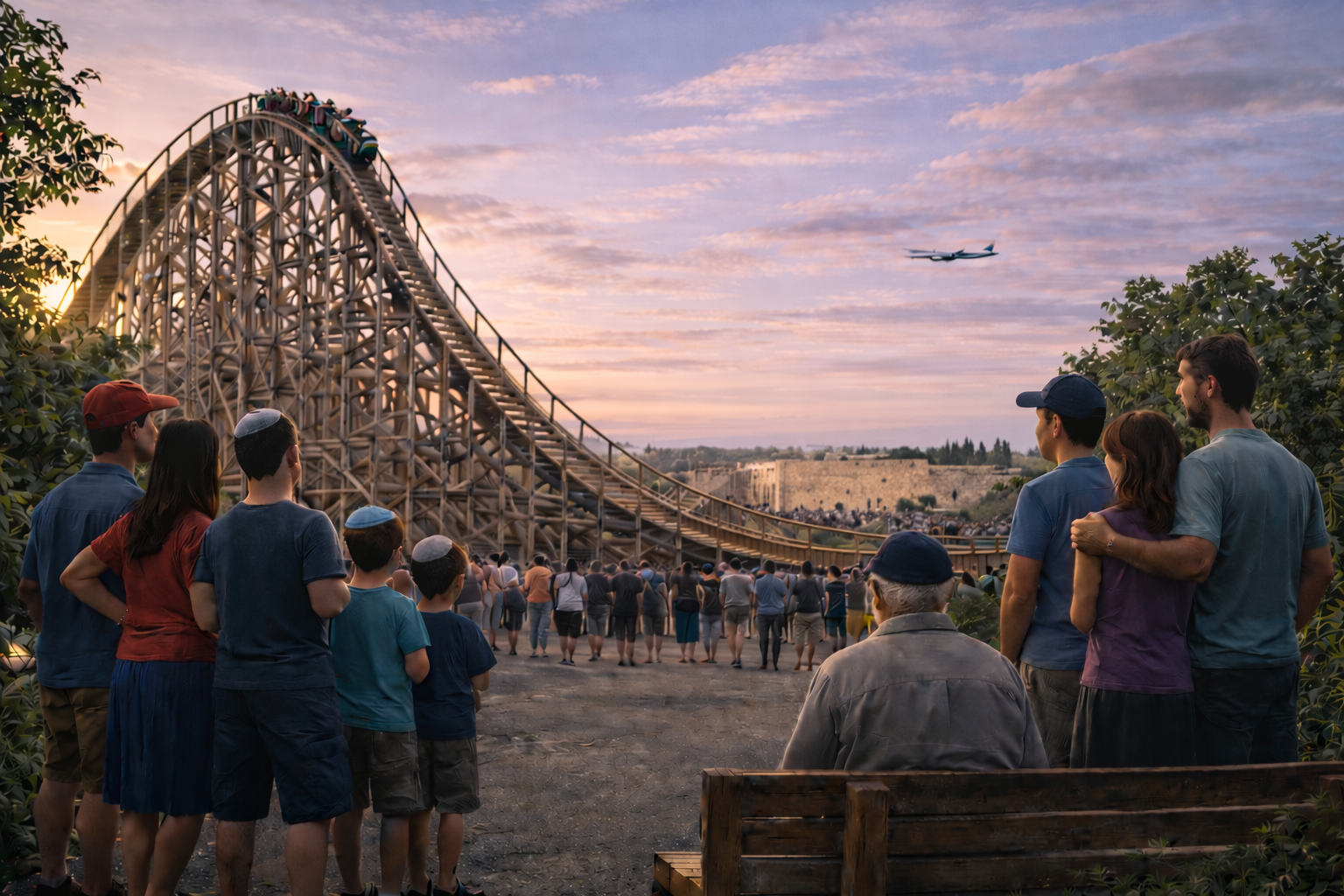
A group of families arrive early in the morning, the kind of early that still carries a hint of quiet before the park fills. There is a shared sense of anticipation, a blend of nostalgia and possibility. Parents point out rides they remember, and children run a few steps ahead, already negotiating what comes first.

And then they see it.

At the far end of the park stands an old wooden roller coaster. It rises higher than anything else around it, its beams crisscrossing in a way that feels both impressive and slightly unsettling. It creaks even when no one is on it. Every few minutes, a train climbs slowly to the top, pauses for a moment, and then plunges down with a roar that draws the eye of everyone nearby.

Some people head straight for it. They don’t hesitate. They move quickly, almost instinctively, as if this was always the plan. Others slow down as they approach, watching carefully, taking it in from a distance. A few stop altogether, standing off to the side, arms folded, unsure.

At first, the differences are quiet. One person says, “We’re going on.” Another says, “I think I’ll wait.” No one feels the need to explain very much.

But as the lines form and the day gets underway, something begins to shift.

Those heading toward the ride start to look back at the ones who are lingering. “You’re not coming?” someone calls out. “This is the best thing here.” There’s laughter, a bit of disbelief. “You came all the way here, and you’re going to stand on the side? What’s wrong with you?”

And among those most hesitant, there are responses, as one would expect. Some light, some sharper. “It looks unstable.” “Did you hear that noise?” “I read somewhere that these things aren’t as safe as they used to be.” Someone adds, “I don’t understand why anyone would take that risk.”

Now the conversation has changed. It’s no longer just about a choice. It has become about justification.

Those in line begin to strengthen their case. “Come on, it’s completely safe.” “Thousands of people ride this every day.” “You’re worrying about nothing.” Their voices carry a certain confidence, but also a subtle insistence. They are no longer just choosing, they are persuading.

Those standing off to the side respond in kind. “Nothing is completely safe.” “You don’t know what could happen.” “People always regret things like this.” The language grows broader, more absolute. What began as hesitation becomes an argument.

And yet, if you step back and listen carefully, something feels off.

The people in line sound a little too certain. As if they need the ride to be entirely without risk in order for their choice to make sense. And the people on the ground sound a little too alarmed. As if they need the ride to be inherently dangerous in order to justify staying put.

But neither is quite true.

The ride is not perfectly safe, and it is not inherently reckless. It is a towering, old, exhilarating machine that draws some people in ways others are not.

Off to the side, not far from where the entrance gate opens and closes, sits an older man on a wooden bench. Most people don’t notice him at first. He is not calling attention to himself or directing traffic. But every so often, someone walks over to him, and when they do, they speak with a certain deference.

It turns out he is the one who built it. Years ago, when the park was still being shaped, he designed the ride, oversaw its construction, and stood at the top of that first hill when it ran for the first time. He knows every beam, every turn, every creak in the wood. He knows what it was meant to be, and why it was made the way it is.

He watches the people moving back and forth between the line and the open space below. He hears the conversations, the confidence, the warnings, and the persuasion on both sides.

Someone sits down next to him.

“Is it safe?” they ask.

He pauses for a moment before answering.

“It’s a real ride,” he says. “It moves, it lifts you, it drops you. It’s not meant to feel the same from start to finish. But it was built carefully. It holds.”

The person nods, not entirely satisfied.

Another person asks, “Is it worth it?”

He looks at the track for a moment before responding.

“I built it because I believed it was worth building,” he says. “Not as one attraction among many, but as something the park, in a deeper sense, was meant to have. There are things you experience on that ride that you won’t experience anywhere else here.”

“And if someone doesn’t go?”

“They will still spend the day in the park,” he says. “There are other things to do. But they will not have that experience.”

There is no edge in his voice, just clarity.

A third person, more agitated, gestures toward the line. “They’re acting like it’s everything,” he says. “Like if you don’t go, you’re missing out on the whole day.”

The old man considers that.

“It is not everything,” he carefully says. “But it is not nothing either. It is a central part of what this place is meant to be. That’s why I built it.”

He lets that sit for a moment.

“But I also built it knowing something else,” he continues. “That people would come to it differently. Some would run to it. Some would stand back. Some would take time. And some might never get on at all.”

“Why would you build it that way?” the man asks.

“Because people are not all standing in the same place,” he says. “Not in what they’re ready for, not in what they’re drawn to, not in what they can carry at a given moment. If I had made it in a way that forced everyone on at once, it wouldn’t be what it is.”

He watches as another train climbs slowly toward the top.

“I can tell someone what it is,” he says. “I can tell them that, in a certain sense, it belongs at the center of this park. But I cannot decide for them when they step into the line. That part is theirs.”

As the day goes on, people continue to choose. Some board the ride, some don’t. Some change their minds halfway through the afternoon. Some return again and again. Others remain content where they are.

The arguments continue too, here and there, rising and falling in intensity. But near the bench, the tone is different.

“How was it?” someone asks a rider who has just stepped off.

“It was incredible,” they say, describing the rush, the height, the sudden drops. “You should try it.”

Another rider says, “It was a lot. I’m glad I did it, but I understand why someone wouldn’t.”

Neither sounds like they are trying to win an argument. They are answering a question.

And those who choose not to go, when they are at their most honest, don’t reach for sweeping claims about danger or certainty.

“I’m not ready,” one says.

There is a quiet honesty in that, a kind of clarity that all the arguments lack. It does not diminish the ride, nor does it judge those on it. It simply names where a person is.  There is nothing wrong with saying it. There is no need to defend it, and no one should be made to feel small for it.

The old man remains on the bench, watching, listening, understanding something that few others fully articulate. 

He knows what He built, and He knows why it matters.  

And He also knows that the path to it, for each person, unfolds in its own time.

Postscript:

This essay was written from Teaneck, NJ, by someone who has not yet made the journey it describes. It was written primarily for others standing in a similar place.

Those living in Israel may read this and feel that something essential is absent, and they would be right. The life being described here in the language of analogy and reflection is, for them, not an abstraction. It is lived in concrete daily choices, in sacrifice, in vulnerability, in a quality of commitment that cannot be seen or felt from a distance. More pointedly, those living in Israel are carrying a weight that others are not, bearing risks that others are not, and raising children in circumstances that others are not, while those on the outside continue to benefit from a Jewish state that others are sustaining with their lives. To frame that asymmetry as simply a difference in readiness can, from the inside, feel not just incomplete but evasive. That critique has genuine force, and it deserves to be honored rather than argued away.

In short, what this mashal does not attempt to capture is the national dimension of this question. The mashal focuses on personal decision-making, on where an individual stands, what they are ready for, and how they find their way. But Aliyah is not only a personal question. It carries a communal and national weight that personal choice language does not reach. There is a version of this conversation that needs to be direct, even unapologetic, one that names a collective and historic calling, and even a responsibility, without softening it into a lifestyle consideration, and that does not treat what is being asked of an entire people as simply a matter of individual timing. That conversation is important and necessary. It deserves its own voice, its own directness, and its own moment.

This essay is not that conversation. It is an attempt at the other one, offered honestly and with full awareness of its limits, for those still finding their way.


Not So Fast: Leadership Is a Process, Not a Moment

What does it actually mean to lead well? Not to be correct, not to be knowledgeable, not even to be respected, but to genuinely influence the people in your care over the long term? The first Mishnah of Pirkei Avos, which we began this past Shabbos, may have more to say about it than we typically notice.

Between Pesach and Shavuos, it is customary to study a chapter of Pirkei Avos each Shabbos, a practice that frames the weeks of Sefiras HaOmer as a time not only of counting, but of character-building. The first Mishnah records the chain of tradition: how Torah was transmitted from Sinai through the generations until it reached the Anshei Kneses HaGedolah, the Men of the Great Assembly. Their contribution to that chain was not a piece of esoteric wisdom or a complex legal ruling. It was three simple directives:

הֱווּ מְתוּנִים בַּדִּין, וְהַעֲמִידוּ תַלְמִידִים הַרְבֵּה, וַעֲשׂוּ סְיָג לַתּוֹרָה

“Be deliberate in judgment, raise many students, and make a fence around the Torah.” (Avos 1:1)

At first glance, these look like three separate ideas, practical guidance drawn from three different domains of rabbinic life. The first speaks to the act of decision-making. The second to the cultivation of the next generation. The third to the protection of Torah observance. One could easily study each on its own, draw a distinct lesson, and move on. And in fact, that is how these teachings are often approached, as three independent imperatives, each worthy of its own attention.

But there is a stronger reading. Look again at the three directives together. Perhaps they are not a list, but rather a sequence. Upon reflection, there appears to be a common thread running through them, a single philosophy of leadership unfolding in stages. Each principle makes the next one possible. Remove any one of them, and the others lose their footing.

Everything begins with the first principle: be deliberate and patient in matters of judgment.

Being deliberate does not simply mean thinking carefully. It means being measured, patient, and intentional, resisting the impulse to react, even when something seems obviously wrong, and asking, before speaking or acting, what the goal actually is.

Is the goal to express truth as quickly and forcefully as possible? Or is the goal to influence, to guide, to shape long-term growth? These are not always the same thing.

For example, a rabbi may be entirely correct in identifying a problem or articulating a standard. But if that message is delivered without deliberation, without sensitivity to timing, context, and audience, it may fail at its actual purpose. Worse, it may alienate the very people it was meant to reach. Correctness alone does not create connection. And without connection, even the most accurate message can go unheard, not because it was wrong, but because it was not yet receivable.

This is where the second teaching comes into view: raise many students.

Influence is not created through isolated moments of correctness. It is built over time, through trust, relationships, and credibility. People are drawn to those who understand them, who respect their experience, and who speak in ways that feel relevant and sincere. Without that connection, even the most accurate message falls flat. With it, even difficult conversations can be received and internalized.

But the second teaching only takes hold if the first is in place. Without deliberateness, without the patience and intentionality that a genuine relationship requires, one cannot truly build students. The connection that makes influence possible does not happen by accident. It is the fruit of consistent, thoughtful engagement over time. A rav who leads with reaction rather than reflection may win arguments, but will struggle to build the kind of lasting relationships through which real teaching happens.

Only then can we arrive at the third goal: make a fence around the Torah.

Protective boundaries, communal standards, and the reinforcement of halachic values are essential. But they cannot exist in a vacuum. A fence is only effective when it is embraced by a community that feels connected to the one who built it. Imposed without relationship, it will not hold. Introduced thoughtfully, gradually, and with a genuine understanding of the people it is meant to serve, it can become something the community itself upholds and defends, not as an external constraint, but as an expression of shared values.

And so the sequence becomes clear: without deliberateness, one cannot build students. Without students, one cannot create lasting fences.

What at first appeared to be three separate ideas turns out to be one coherent vision, a philosophy of leadership in which each stage makes the next one possible. The Anshei Kneses HaGedolah were not offering a checklist. They were describing a way of being, a model of rabbinic leadership rooted in patience, relationship, and long-term thinking.

The work of leadership, especially in areas that touch on identity, dignity, and personal experience, demands patience. It demands restraint. It demands a willingness to think not only about what is right, but also about how to bring others toward it.

We are in the middle of a counting. Forty-nine days of deliberate, unhurried movement toward something we cannot yet fully see. Perhaps that is the deepest lesson of this season, that the most important things are never rushed, that influence worth having is influence worth waiting for, and that the work of building something lasting always begins with a single, careful step.

Between a Giant Step and a Splitting Sea

What was the weather like the day before the most important moments in history? What was it like when Avraham left his home, when Yaakov returned, when Moshe first stood before Pharaoh? We do not know. The Torah does not tell us. There is, however, a particular moment, a strikingly unusual one, where the Torah goes out of its way to describe the conditions in detail, almost as if offering a kind of weather report that does not seem essential to the story itself.

The night before the splitting of the sea: וַיּוֹלֶךְ ה׳ אֶת הַיָּם בְּרוּחַ קָדִים עַזָּה כָּל הַלַּיְלָה

Hashem drove the sea back with a strong east wind all night. Not a sudden rupture, not a dramatic explosion, but a wind, steady and continuous, working through the night.

That detail is striking. It forces a different kind of question. Not just what happened, but why we are being told this at all. Why here, of all places, does the Torah pause to give what feels like a kind of weather report? Why is it important for us to know that it happened through a steady wind blowing through the night? And why present it in a way that leaves open how we are meant to understand it?

As we speak, four astronauts are on their way back to Earth from the Artemis II mission, a journey that has taken them over 220,000 miles, farther than any human beings have traveled in over 50 years. They left Earth’s orbit, circled the Moon, and for a period of time passed behind it, completely cut off from communication. For those moments, there was total silence, no signal, no contact, and yet everything continued exactly as planned.

When the astronauts described what they experienced, their focus was not on control or conquest. They spoke about awe. They described seeing the entire Earth at once, continents and oceans, light and darkness meeting at the horizon. They described looking at the far side of the Moon, a place no human being naturally sees. What they returned to again and again was not what they had accomplished, but what they felt, a deep sense of smallness, of being overwhelmed, of being moved by what they were seeing. Humanity reaches farther than ever before, and what we discover is not our power, but our perspective.

That insight brings us back to the sea, because embedded in that original question is a deeper one. What exactly is a miracle? We tend to assume that a miracle is something supernatural, something that breaks the rules, something that cannot be explained. But the Torah’s description complicates that assumption. If a sea can split through a wind that blows all night, then perhaps a miracle is not defined by how it happens, but by how it is experienced.

That possibility leads to a more difficult question. If miracles are not limited to the suspension of nature, then why do they seem so rare? Or perhaps they are not rare at all, but we have lost the ability to recognize them. Perhaps the purpose of a miracle is not to overwhelm us with spectacle, but to train us to see differently, to look at the same world and perceive something deeper within it.

Rabbi Jonathan Sacks zt”l suggested that the Torah’s dual description is not a contradiction but a challenge. A miracle is not defined by how dramatically nature is suspended. A miracle is defined by whether it changes us, whether it awakens something within us.

The Torah itself hints to another dimension of that night, not only in the splitting of the sea but in what happened to the Egyptians: וַיָּסַר אֵת אֹפַן מַרְכְּבֹתָיו

The wheels of their chariots came off. Their greatest strength, their advanced technology and power, turned against them at the decisive moment. The very system they relied upon failed when they needed it most. Was that a miracle, or was that a mechanical failure? Once again, the Torah leaves space for the question rather than resolving it.

That same question has echoed in our own experience. For the second year in a row, as Pesach approached, a barrage of hundreds of missiles was launched toward Israel. Based on every reasonable projection, the expectation was devastation. And yet, they were intercepted, nearly all of them. Was that a miracle, or was that technology? Was that divine protection, or was that a system operating at peak capacity?

The question itself is familiar. Wind or sea. Chariots or collapse. Technology or miracle. The categories begin to blur, and perhaps that is exactly the point.

The Ramban writes that open miracles exist to teach us how to see the hidden ones, that there is no such thing as a purely natural event, only a world whose consistency has dulled our sense of wonder. We grow accustomed to the regularity of the world, and in that familiarity, we stop noticing what is in front of us.

And sometimes, all it takes is distance to restore that sense of awareness. When astronauts leave the Earth and look back, what was once ordinary becomes overwhelming. The same world we move through every day suddenly appears breathtaking, fragile, and impossibly precise. Nothing has changed. Only perspective.

That may be what the Torah is doing by describing the wind. It is not diminishing the miracle; it is expanding it. You can call it wind, you can call it a miracle, but the Torah is asking something deeper. What do you see, what do you feel, and what does it do to you?

Because if it leaves a person unchanged, then even the splitting of the sea will fade into memory. And if it awakens a person, then even something as subtle as a steady wind can become a moment of revelation.

We are not standing at the sea, nor are we orbiting the Moon. But we are living in a world no less precise, no less fragile, no less filled with meaning. The question is not whether Hashem reveals Himself. The question is whether we have trained ourselves to notice.

Because the sea may not split the way it once did. Sometimes it comes as water. Sometimes it comes as wind. Sometimes it comes as events that can be explained away entirely. But if we learn to look properly, we may discover that we have never stopped walking between walls of water.

Maybe we have just stopped looking up.

It’s Time. Move.

The miracle of K’rias Yam Suf didn’t begin when the sea split. It began in the moments just before, when it looked like there would be no miracle at all.  It began when Pharaoh’s chariots thundered in from behind, the sea stretched cold and impassable ahead, and Bnei Yisrael stood trapped between them, with no road, no plan, and no way out. Every direction had been sealed. Every option had run dry. By every measure available, the story had already ended. The walls had closed in, and there was simply nothing left to do.

And so Bnei Yisrael does the only thing that remains. They cry out. They scream. They beg Hashem for help, and their voices rise together in desperation toward heaven.

And then Hashem says something that still stops us cold: מה תצעק אלי? Why are you crying out to Me? Why are you screaming?

This sharp rebuke is quite startling. After all, this would seem to be the moment that prayer was designed for, when human power has run out, when the situation is beyond anything we can control or fix, when there is genuinely nowhere else to turn. These seem to be precisely the conditions under which we have always been taught to pray, not as a last resort, not as a sign of helplessness, but as one of the most powerful and dignified responses available to us. So what, exactly, is Hashem objecting to?

And then Hashem continues: דבר אל בני ישראל ויסעו, “speak to the people, and tell them to move forward.” Move? Move where, exactly? There is nothing in front of them but water, open, deep, unyielding water. The instruction seems impossible, even absurd.

I think the answer to both questions lies in the same place. Hashem was not telling them to stop praying — He was redirecting them toward a different kind of prayer, one that reaches upward rather than collapses inward. Yes, we are always supposed to pray. Prayer is never wrong, and reaching toward Hashem is never misplaced. But not all prayer is the same thing. What erupted from the people was a צעקה, a primal scream, raw and unfiltered. And the difference between a צעקה and a תפילה is not merely one of style or intensity. It is a difference of inner direction and spiritual orientation. A תפילה, even a desperate one, is an act of reaching, of turning toward Hashem in longing, with the implicit belief that Hashem is there, that Hashem hears, that the relationship is real and the future is open. A צעקה, by contrast, is not really directed anywhere. It erupts from within rather than reaching toward something. It is the sound a person makes when they have already, somewhere deep inside, given up. It is not a prayer of trust or longing. It is the sound of collapse, the voice of someone who no longer believes the story can change.

And when we collapse into that kind of despair, something happens to our perception. We lose the ability to see what may already be possible. Hopelessness doesn’t just make us feel bad. It actively distorts our vision. It narrows our sight, flattens our imagination, and tells us the story is finished when it isn’t. It keeps us locked inside a prison even when the door is already standing open, because we’ve stopped looking for the door at all.

So Hashem says: Stop screaming. Start moving.

What happens next is one of the greatest acts of courage in Jewish history. Nachshon ben Aminadav doesn’t wait for the water to part before he steps forward. He doesn’t demand certainty before he commits. He hears the command “move,” and he moves. He steps into the sea. Nothing happens. The water doesn’t shift. The sea doesn’t respond. But he keeps walking, one step and then another, even as the water rises around him, even as nothing visible confirms that this is the right thing to do. And only then, not before, not immediately upon his first step, but gradually, as he continues forward, does the sea begin to split. Not all at once, not in one dramatic instant, but unfolding before him, step by step, as he walks. The miracle did not exist ahead of him, waiting to be discovered. It came into being because he moved. His trust, his willingness to act without guarantees, was the very thing that called the miracle forth.

This, I believe, is the essential message of Shevi’i shel Pesach. There are moments in every life, and perhaps in every generation, when we genuinely cannot see a future. When we feel trapped, exhausted, finished, as though the walls have truly closed in and there is no longer any realistic path forward. These are the moments when despair begins to feel not just understandable but rational, even honest. And into precisely those moments, the Torah speaks with great clarity: that feeling is not the truth. The story is not over.

Rav Tzadok HaKohen of Lublin writes that despair has no legitimate place in a Jewish life: אין ליהודי להתייאש משום דבר. Not in the physical world, and not in the spiritual one. No matter how far someone has fallen, no matter how tangled, broken, or stuck they feel, no matter how many times they have tried and failed, there is no point at which transformation becomes truly impossible. There is no situation so closed that Hashem cannot act within it.

And then Rav Tzadok goes further still: the entire Jewish people begins after total despair. Avraham and Sarah had long since let go of the dream of having a child. The years had passed, the biology had spoken, and the hope had quietly died. Even after Hashem promised them a son, Sarah laughed, and her laughter was not cynical or dismissive. She believed in Hashem’s power in the abstract. But she could no longer genuinely imagine that the impossible remained possible for her, in her body, in her life. The gap between the promise and reality had simply grown too wide to bridge in her imagination. And precisely at that moment of maximum impossibility, that is when the Jewish nation begins. Not in a moment of strength or confidence or clarity, but in a moment when every human measure said: this cannot happen. Because that is what it means to be a Jew. To hold on when there is nothing left to hold. To move when there is no visible road. To keep walking even when the water is still rising.

The birth of Yitzchak. The splitting of the Yam Suf. Nachshon walking deeper into the water with each uncertain step. These are not three separate stories that happen to share a theme. They are the same story told again and again across the generations, because every generation needs to hear it again, and because every individual life will eventually arrive at its own version of the sea.

The Gemara in Brachos (10a) expresses this idea in terms that have echoed through Jewish history: אפילו חרב חדה מונחת על צווארו של אדם אל ימנע עצמו מן הרחמים, even with a sword pressed against one’s neck, a person must not cut himself off from the possibility of mercy. Even at the last possible moment, even when the situation appears completely and utterly final, we do not surrender hope. Because ישועת ה׳ כהרף עין, the salvation of Hashem can come in the blink of an eye, in ways we could not have anticipated or imagined. The moment we decide it’s over is the moment we stop seeing what Hashem might still do.

When we surrender to the voice of despair that says the sea will never move and the walls will never open, we lose our capacity to perceive the openings that may already be forming before us. But when we find the courage to trust, even partially, even imperfectly, even in the dark and without any guarantee, and we place one foot in front of the other and keep moving, that is when things begin to shift. That is when paths emerge from places that seemed to hold nothing. That is when seas begin to split.

Redemption doesn’t always arrive before we move. Sometimes, perhaps more often than we realize, it arrives because we move. The miracle wasn’t waiting at the other side of the sea. It was waiting inside the decision to step forward. And the path that seemed impossible turns out to have been there all along, just beneath the surface, waiting for someone willing to move.