
Perhaps Not This Year, But Certainly Over Time

לע”נ אילנה חנה בת יוסף אברהם ז”ל

Each year, we sit at the Seder and say words that are both familiar and demanding: בכל דור ודור חייב אדם לראות את עצמו כאילו הוא יצא ממצרים. We are not asked to remember the Exodus. We are asked to see ourselves inside it. In every generation, a person is obligated to see himself as if he personally left Mitzrayim. That requires a certain kind of imagination and a certain kind of internal alignment that we don’t always fully appreciate.

But before even getting there, there is a basic question about the way the Mishnah is formulated. The Seder is something we experience each year. The mitzvos of the night, matzah, maror, the four cups, are all annual obligations. So you would expect the Mishnah to say that each year a person must see himself as if he had left Mitzrayim.

But that’s not what it says. It says: בכל דור ודור. In every generation. And that’s difficult to understand because this isn’t something that applies once in a generation. It’s something we are meant to engage with every single year. So why frame it that way?

Perhaps the answer lies in the kind of mitzvah this is. There are mitzvos that ask us to do something, and those we can do regardless of how we feel. A person may not be in the mood, may be distracted, may be dealing with a lot, but he still eats the matzah and drinks the ארבע כוסות. The action stands even if the feeling is not there.

But this mitzvah is different. It is not only about what we do, but about how we see and how we feel. And that makes it far more demanding. Some of the greatest giants have noted that this may be among the most difficult mitzvos of the night, precisely because it asks a person to enter into an internal reality, not just perform an external act.

And yet, it remains an obligation each year.  A person is expected to try, to engage, to open himself to that perspective, even if it does not come easily, and even if it cannot be fully realized. The mitzvah does not disappear simply because the feeling is not there.

At the same time, Chazal understood something very real about life. There are years when a person sits at the Seder, says the words, fulfills all the actions, and still does not feel as if he is leaving Mitzrayim. Life can be heavy in ways that are not easily set aside, illness, financial strain, family challenges, or simply an internal sense of being stuck.

That is where the language of בכל דור ודור becomes so important.  A דור is not just a stretch of time. It is a vantage point. It allows a person to look backward a bit and forward a bit, to see where they have come from and to have some sense, however limited, of what may still lie ahead. It places a person not only in a moment, but within a story.

And when a person looks at their life that way, something begins to shift.  If you look only at the present, it may be hard to speak about geulah. But if you step back, five years, ten years, twenty years, you begin to notice movement. Things that once felt fixed were not as permanent as they seemed. Situations evolved. People grew. Even difficulties that did not disappear often changed in form or in weight. And that is true not only for individuals but also for families and for our people as a whole.

When we think about a דור, we are also thinking about those who came before us and those who come after us. We can look back at what earlier generations endured and what they built, and we can look forward to seeing how things continue to unfold beyond us. Over that span, there is movement, uneven, sometimes slow, but real.

And within that broader view, it becomes easier to recognize something that may not be visible in any single year: that there are moments of יציאה. Not always dramatic, and not always complete, but real. Moments when something that once held us no longer does, when a situation opens even slightly, when a person finds a bit more space than they had before.

There may be years when a person sits at the Pesach Seder and simply cannot feel as if they are leaving Mitzrayim. You can go through the motions, say the words, do everything you’re supposed to do, and internally, it’s just not there. But the avodah of the Seder is not to force a feeling that isn’t there. It is to try to move toward it, even in a limited or partial way, and to place ourselves within a larger story in which that feeling can, over time, become more visible and more real. Because בכל דור ודור, over time, across the span of a life, it is possible to look back and say: I have known something of מצרים, and I have also, at times, moved beyond it. Not always in any single year. But within the unfolding of a דור.

And perhaps that is what is being asked of us, not to create a feeling on demand, but to continue showing up to the story, year after year, with honesty and with openness, until we are able to see ourselves within it.

What Would It Take? Even the Loudest Voice Has Its Limits

At times, we each wonder what it would have been like to be there. Standing at the shore of the Yam Suf, watching Egyptian archers draw their bows, only for the arrows to shatter against a cloud that has no business being there, a pillar of divine fire and glory, exactly as our rabbis described it. And we imagine: if I had been there, if I had seen that with my own eyes, everything would have been different. I would have known. There would have been no question, no doubt, no wondering.

And yet, in a certain sense, we are standing there.

Over the past two and a half years, we have witnessed wave after wave of events that, taken together, are genuinely difficult, if not truly impossible, to explain away. Missile barrages numbering in the hundreds, carrying real destructive potential, repeatedly intercepted in ways that limit what could have been mass casualties. Operations reaching individuals long considered untouchable, in environments presumed secure, executed with a precision that defies ordinary expectation. The pager operation, which effectively dismantled terrorist communication networks overnight and led to the neutralization of large numbers of terrorists. Moments of potential escalation across multiple fronts that by every strategic logic should have widened into something far larger, and yet, again and again, stopped short. Rockets that misfire, land in empty fields, or are neutralized at the last possible moment. Hostages returned under circumstances that would have predicted something far more tragic.

Each of these moments, taken alone, can be explained (perhaps, anyway). Taken together, though, they accumulate into something that presses for a different kind of accounting.

And yet, many of us still find ourselves waiting. Not ungrateful, but still waiting. As though what we are witnessing does not quite match the image we carry of what unmistakable clarity is supposed to look like. We imagine it arriving differently, more overt, less open to interpretation, impossible to dismiss.

Which is precisely the question that the opening of Sefer Vayikra places before us.

וַיִּקְרָא אֶל מֹשֶׁה וַיְדַבֵּר ה’ אֵלָיו מֵאֹהֶל מוֹעֵד לֵאמֹר

Rashi, drawing on Chazal, highlights two things in close succession. First, the voice of Hashem reached Moshe, but the rest of Bnei Yisrael did not hear it. And then the detail that Rashi cannot let pass without comment: מִלַּמֵּד שֶׁהַקּוֹל נִפְסָק וְלֹא הָיָה יוֹצֵא חוּץ לָאֹהֶל

The voice stopped at the boundary of the Ohel. It did not pass through.

But this was not a quiet voice. Chazal describe it in the language of Tehillim: קול ה’ בכח… קול ה’ בהדר… קול ה’ שובר ארזים. It was a קול גדול, a voice of shattering force, not diminished, not fading, not limited in its strength.

Reb Moshe Feinstein zt”l, in Kol Ram, presses on what seems like a contradiction. If the voice was going to be contained anyway, if it was not meant to reach beyond Moshe, why structure it as a קול גדול at all? Why not simply a קול נמוך, a quieter voice proportionate to its limited reach?

His answer does not merely resolve the question. It reframes a fundamental aspect of how revelation works.

The power of the קול and the boundary of the קול are two entirely separate matters. One does not determine the other. The voice can be of immense, world-shattering force, קול ה’ שובר ארזים, and still not pass through the wall. Not because it is weak, but because that is how the world is structured. Presence does not force recognition.

We tend to imagine otherwise. We tell ourselves that if we had stood at Yam Suf, if we had witnessed the מכות, if we had lived in the דור המדבר, surrounded by ענני הכבוד by day and אש by night, clarity would have been inevitable. The evidence would have been impossible to dismiss. But the Torah does not allow us this assumption.

The דור המדבר did live in that world. The קול was not faint. The presence was constant and overwhelming. And still they struggled, complained, and fell. Not because the evidence was insufficient, but because human beings are not passive recipients of reality. We are interpreters of it. And interpretation depends on something the evidence alone cannot determine.

Which returns us to where we began. The accumulation of these past two and a half years is not small. The pattern is not subtle. Repeated missile barrages that fall far short of their intended devastation. Defensive systems operating with remarkable consistency under relentless pressure. Operations that reach individuals and networks thought to be beyond reach. Disruptions that dismantle coordination and neutralize large numbers of terrorists. Escalations that appear poised to spiral into something far broader, and yet repeatedly stop short. Outcomes that, again and again, land on one side of what might have been.

Each individual moment can be explained. Taken together, they begin to press on us. But the question was never whether the קול is powerful enough.  

מִלַּמֵּד שֶׁהַקּוֹל נִפְסָק. The voice stops at the boundary, not because it lacks force, but because that is how this world is built. A קול גדול can fill the space and still not pass through. Not because it is absent, but because it does not impose itself beyond its set limits.

And so the question is not what else needs to happen. It is what we imagine we are still waiting to see.

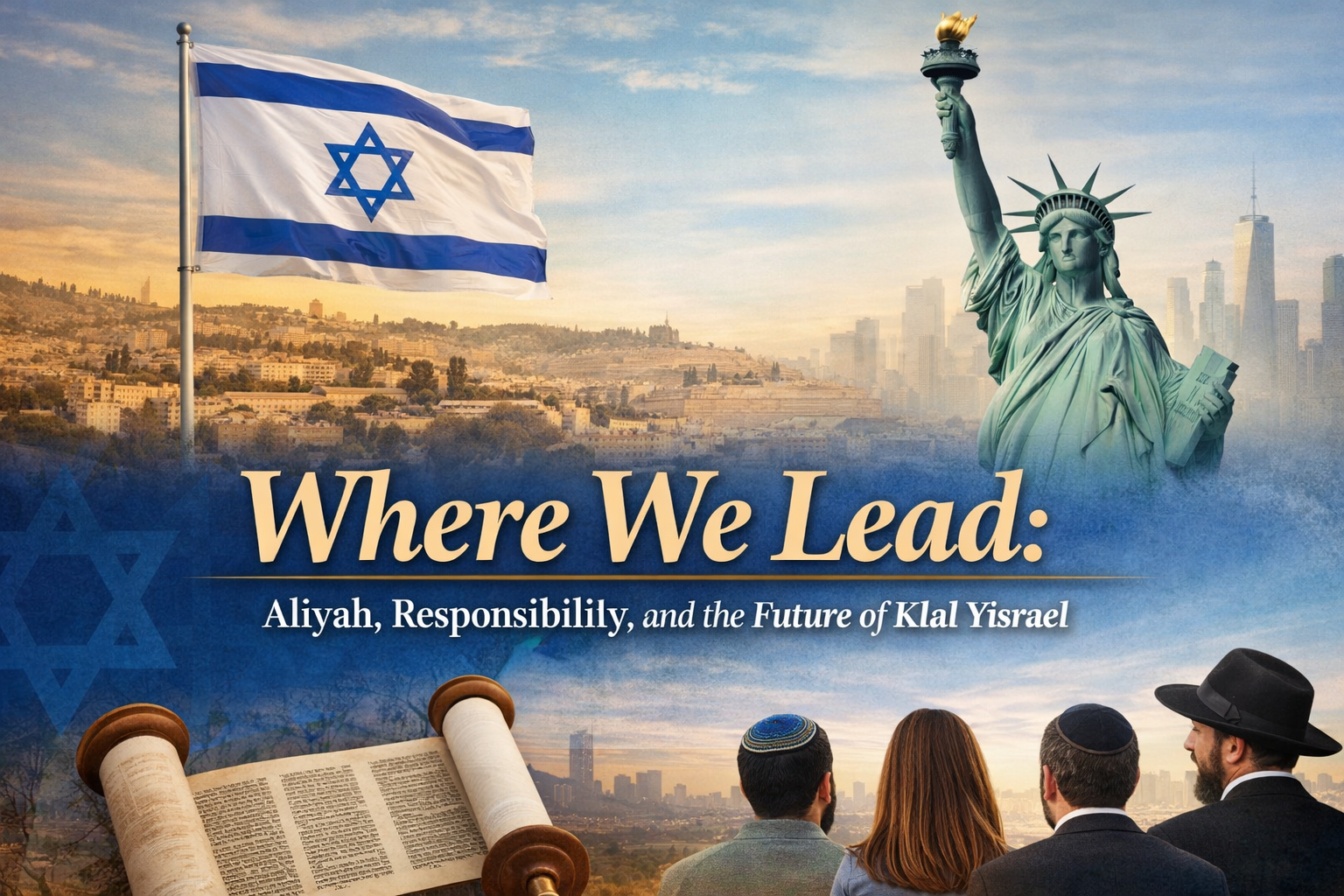
Where We Lead: Aliyah, Responsibility, and the Future of Klal Yisrael

At the recent RIETS dinner, I had the distinct privilege to serve as moderator for a Q&A panel discussion featuring Rabbi Dovid Miller, Rabbi Efrem Goldberg, and Rabbi Yisroel Kaminetsky. It was an honor to facilitate a conversation of such depth and significance. It may be viewed in its entirety here:

Toward the end of the panel, a question was raised that has clearly continued to resonate. In his response, Rabbi Goldberg framed a concern that extended beyond the individual decision of Aliyah to its broader communal implications. In essence, the question becomes: if large numbers of rabbanim and educators were to relocate, what will be with Jewish education and leadership in America? The issue, he powerfully suggested, is not only the individual choice but also the cumulative impact of many such choices.

At the time, I commented that I would have liked to respond but that we had run out of time. As I noted then, it was not the setting for extending the discussion. In the days since, I have received a number of thoughtful follow-ups from people who were curious how I might have addressed that question. I would like to offer a brief reflection.

The concern for the future of Jewish leadership in America is both understandable and important. At the same time, I am not convinced that it should function as a primary determinant in the decision-making process of any individual Rav or educator.

At a fundamental level, there is a distinction between responsibility and the extension of personal obligation beyond what one can realistically affect or foresee. Individuals are obligated to make thoughtful, grounded decisions that take into account their own circumstances, their families, and, where relevant, the communities and institutions to which they are directly accountable. A Rav serving a shul, a mechanech responsible for students, or a leader embedded in a particular institution cannot ignore the real impact of their departure. That is a legitimate and serious consideration (and not the subject of this essay).

At the same time, extending that responsibility to include speculative, large-scale projections about the future of Jewish leadership across an entire country moves beyond the scope of individual obligation. The question of “what will be” if many leaders choose a certain path assumes a level of control and foresight that we simply do not possess. There is a meaningful difference between responsible foresight within one’s sphere of influence and attempting to account for the aggregate consequences of many independent decisions.

Historically and theologically, we have understood that Hashem ensures the continuity of leadership within His people. That does not absolve individuals of responsibility, but it does place limits on the kinds of calculations we are meant to make.

Jewish history reflects a certain humility in this regard. Centers of Torah and leadership have never remained static. They have shifted across continents and generations, often in response to forces far beyond the control of any individual. That reality does not dictate how any one person should decide, but it does suggest that the long-term distribution of leadership within Klal Yisrael has not been shaped through individual attempts to engineer it.

We see a vivid and instructive version of this complexity in the time of Ezra and Nechemiah. When the opportunity arose to return to Eretz Yisrael, the Jewish people did not move as a single unit. A minority returned in waves, while the majority, including many of the greatest Torah scholars, remained in Bavel, where a strong and enduring community continued to develop. The absence of Levi’im in Ezra’s group was so striking that the text records it explicitly: when Ezra assembled the returnees, he discovered that not a single Levi had joined him. He sent recruiters to gather Levi’im, and ultimately, only very few joined (Ezra 8:15–20).

What is notable for our purposes is what we do not find. We do not find a recorded argument that individuals, not the Levi’im, not the Torah scholars, and not the broader community, should remain out of concern that Bavel would be left without leadership if too many departed. There appears to have been an acceptance that Jewish life could develop in parallel centers, rather than requiring preservation through centralized calculation.

It is also worth noting that while this question arises most naturally in the context of Aliyah, given the aspirational desire of many Jewish leaders to participate in what they experience as part of the unfolding geulah, the underlying argument is not unique to that setting. At its core, it asks whether individuals should make decisions based on the projected aggregate impact of many similar choices. That is not something we typically engineer, whether at the local, institutional, or national level. The inconsistency suggests that while the concern is genuine, it may not be the kind of consideration that should ultimately guide individual decision-making.

Ultimately, the question is not whether we care about the future of Klal Yisrael, but how we understand our role within it. We are called to act with responsibility, integrity, and sensitivity to those whose lives we directly shape. But we are not the sole architects of Jewish destiny. The future of Torah leadership has never depended on our ability to calculate its course in advance or to preserve it through collective restraint. It unfolds through a process far larger than any one decision, or even the sum of many decisions. Our task is to lead where we are called, with clarity and with courage, and to trust that the continuity of our people is sustained by a Hand far beyond our own.

The Fall of Persia and the Theology of Purim

Ayatollah Khamenei is dead. Ahmadinejad is dead. The men who stood before the world and called for the annihilation of the Jewish people — who funded the missiles, armed the proxies, built the infrastructure of hatred, and declared openly that Israel must be wiped from the map — did not live to see Purim. Tomorrow is Ta’anis Esther.

We are about to read the Megillah, the story of the Jewish people and Persia locked in existential confrontation. In that ancient world, too, the language of annihilation was not metaphorical. It was written into law. It was signed and sealed. It was backed by state power. The Jewish people stood vulnerable, scattered, and threatened with extinction. And in that moment, history turned.

Now, on the eve of Ta’anis Esther, Persia once again stands in the frame of our story. Once again, the rhetoric of destruction was explicit. Once again, the intention was operational, not symbolic. And once again, those who devoted their lives to our eradication did not survive to see their plans fulfilled. The timing is not incidental. It is staggering.

The Rambam writes at the opening of Hilchot Ta’aniyot that when upheaval strikes a community, and they cry out, they must not dismiss events as a coincidence. To respond by saying, “This is simply how the world works,” he calls achzariyut — a cruelty of the spirit, a hardening that refuses to engage with moral meaning. A fast is not about hunger. It is about clarity. It exists to uproot the illusion of mikreh.

That word lies at the heart of Amalek’s identity. The Torah describes Amalek as אשר קרך בדרך. Chazal hear in that phrase not only an ambush but a worldview. Amalek represents the theology of randomness. History has no Author. Power explains survival. Coincidence explains everything else. The attack is physical, but the deeper assault is philosophical.

That is why the first communal fast in Jewish history appears in the war against Amalek. When Yehoshua fights below, and Moshe stands above with raised hands, Chazal understand that the nation fasted. Fasting was not tactical. It was theological. Amalek says the world is blind. The Jewish response is to declare that it is not.

Purim represents the maturation of that declaration in an age of hiddenness. In the era of open miracles, the Divine Hand was unmistakable. By the time of Mordechai and Esther, prophecy had receded. The Name of Hashem does not appear in the Megillah. The story can be read entirely as a political coincidence: the king happens to depose Vashti; Esther happens to be chosen; Mordechai happens to overhear; the king happens not to sleep; the chronicle happens to open to the right page. Each event alone is plausible. Together they form a pattern too precise to be dismissed.

Haman himself never abandons the language of chance. ויספר… את כל אשר קרהו — everything that happened to him. Even as events close in around him with frightening symmetry, he insists on mikreh. He calls it a coincidence until the gallows stand ready.

Purim trains the Jewish people to discern meaning when the Divine Name is not explicitly written in the text of history. It does not authorize simplistic conclusions or arrogant certainty. It demands that we refuse randomness.

That is why Ta’anis Esther precedes Purim. Before we celebrate hidden salvation, we discipline ourselves to recognize hidden providence. Before we rejoice in reversal, we confront vulnerability. Before we defeat Amalek’s violence, we reject Amalek’s theology.

In moments like this, it is tempting to reduce everything to strategy and geopolitics. There will be endless analysis of intelligence operations, military precision, deterrence frameworks, and regional realignment. Jewish self-defense is a mitzvah. Strength is not a contradiction to faith. But if we speak only that language, we concede the deeper battle. A fast day insists that history is not merely the collision of power blocs. It is a moral narrative unfolding under a concealed but deliberate Hand.

The Rambam does not permit us to assign specific heavenly motives to specific events. He does require that we respond with introspection rather than indifference. A fast calls for unity, for tefillah, for moral refinement, for the rejection of cynicism. It demands that we not become spiritually numb in the face of extraordinary timing.

We do not glorify death. We do not romanticize conflict. We do not pretend to decode Heaven’s calculations. But we also do not avert our eyes from the irony written into this moment. On the eve of Ta’anis Esther, those who built careers on the promise of Jewish annihilation have fallen. Not in Shushan. Not in the desert. Here. Now. In our lifetime.

Amalek’s war was always both physical and philosophical. The Jewish response must remain the same. We defend ourselves with strength. And we fast to remind ourselves that strength alone does not explain survival.

Nothing is mikreh. Not in the days of Moshe. Not in Shushan. Not on the eve of Ta’anis Esther. Not now.