In 1982, Nancy Reagan visited the Longfellow Elementary School in Oakland, CA, as she embarked on her historic national anti-drug campaign. During this visit, she was asked by a young schoolgirl what she should do if she was offered drugs. The First Lady responded, “just say no.” The rest, as they say, is history. “Just Say No” clubs and organizations were established all over the country and one of the most famous slogans in modern times was born. The “Just Say No” rallying cry has since become ingrained in the minds of hundreds of millions of people, spanning all races, ethnicities, and religions.
I wonder however if the Orthodox community has taken Mrs. Reagan’s instructions a bit too far. Indeed, we can all agree that the only proper response from one who has been solicited to accept drugs is “no.” Too often, however, many of us express “no” to the mere suggestion that we discuss drugs at all. Many of us naively believe that the Orthodox community is, more or less, unaffected by the drug epidemic, which so dreadfully affects the general population.
Consider the manner in which many well-intentioned members of our community would likely respond to the following questions:
- Do substance and alcohol abuse and addiction affect members of the Orthodox community, to any significant degree?
- Should we, as a community, organize public gatherings to discuss how best to detect alcohol and substance abuse and introduce methods of intervention and treatment?
- Do substance abuse and addiction afflict individuals who come from supportive families and functional households?
- Do people who are committed to a life of Torah observance and seek to embrace Torah values abuse alcohol or drugs?
- Do individuals who truly appreciate the value of self-control struggle with alcohol or drug addictions?
Did you answer “no” to any of these questions? If you are like most of us, then you probably have. The uncomfortable truth, however, is that the answer to all of these questions is a resounding “yes.”
- Yes, substance and alcohol abuse and addiction undeniably affect a significant population within the Orthodox community.
- Yes, we must absolutely come together as a community and discuss methods of detection, intervention, and treatment of alcohol and substance abuse.
- Yes, substance abuse and addiction often affect members of supportive families and functional households.
- Yes, it is not uncommon for individuals who are genuinely committed to Torah observance and values to develop addictions to alcohol and drugs.
- Yes, most often, individuals who struggle with alcohol and drug addictions thoroughly and deeply understand, appreciate, and value the virtue of self-control, despite their destructive behaviors.
But why the disconnect? Why does our community so glaringly miss the mark on this particular issue? After all, our community consistently displays profound sensitivity to the needy and disadvantaged, demonstrates care and concern for the weak and vulnerable, and is typically proactive in addressing the myriad of social issues that affect the members of our community. Why then do we seem to possess a lapse in awareness and deficient sensitivity when it comes to the issue of alcohol and substance abuse and addiction? It is my impression that many Orthodox Jews (simply) lack information, exposure, and context, all of which would enable us to develop a more informed, nuanced, and accurate perspective of the reality. Our detachment from the facts on the ground does not reflect insensitivity or indifference. Rather, our disconnect is, among other things, a reflection of our limited exposure, inadequate education, and impaired understanding.
Whatever the underlying causes of our disconnect may be, its effects, albeit unintended, are no less harmful and destructive. The common misconceptions that we, as a community, continue to harbor and, at times promulgate, clearly and predictability obstruct our collective ability to responsibly and effectively address substance abuse and addiction. The longer we maintain the belief that members of our community are either immune to or unaffected by alcohol and drug abuse, we fuel the fires of stigmatization, causing our very own friends and neighbors to shoulder their hefty burden alone. The longer we allow ourselves to view the families of those who suffer from addictions with prejudice and presume their shared culpability in their child’s/spouse’s/sibling’s/parent’s addiction, the further we estrange those who desperately need comfort, support, and reassurance. The longer we view alcohol and substance addiction as a failure of character, rather than what it actually is – a physiological illness, we further alienate members of our community who may already feel helpless and ashamed. As individuals, we must band together and inspire a paradigm shift in the way we approach alcohol and drug addiction, recognizing it for the illness it is. As a community, we must hold ourselves accountable, knowing that there are those among us who are afraid to come forward and step into the light, lest they be unfairly judged, mislabeled, and misunderstood. We must learn to encourage and embrace those struggling with addiction, as well as their families, assisting and supporting them on their road towards healing and recovery.
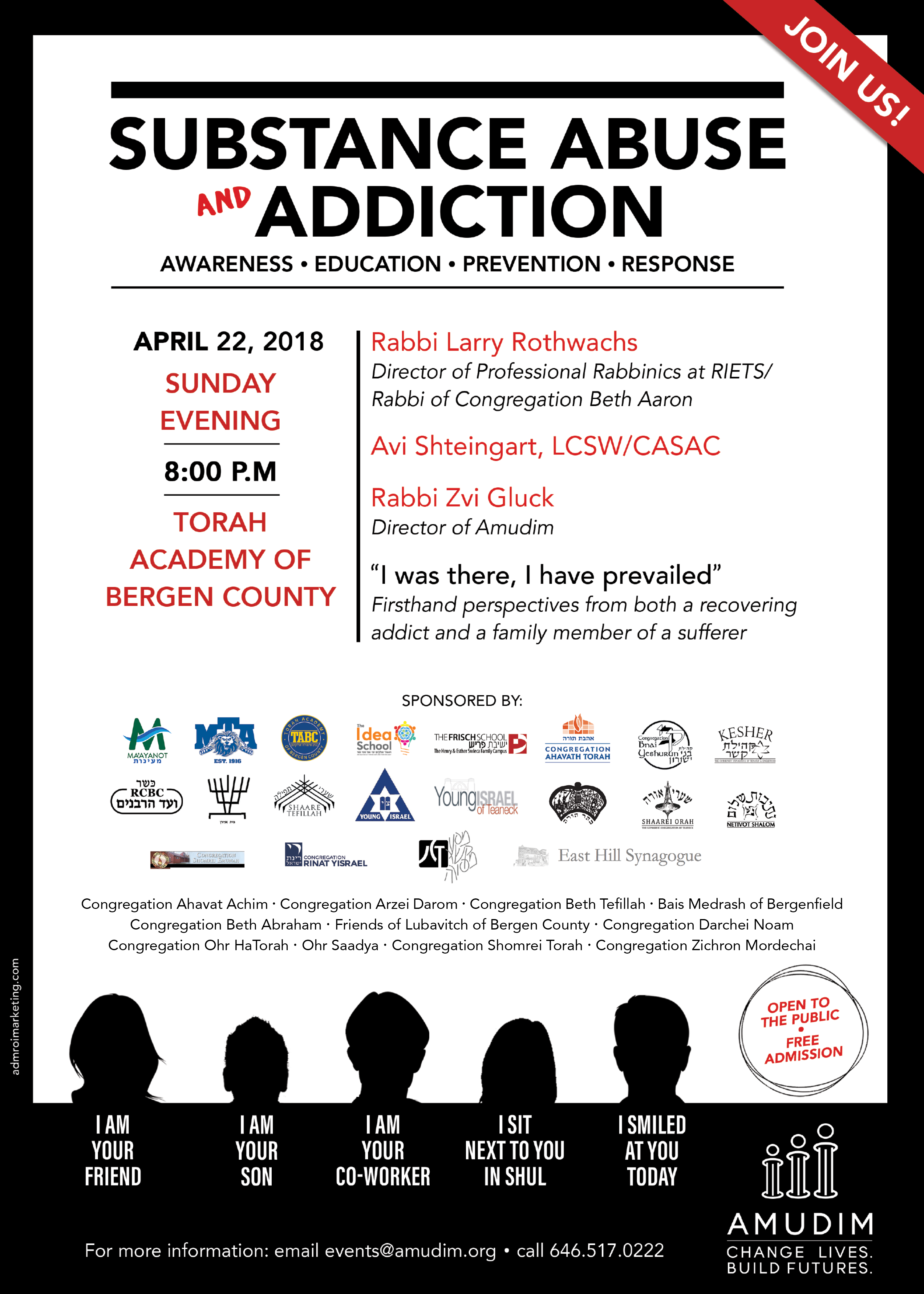
Needless to say, success in achieving such a radical and fundamental shift in thinking and action will take time, effort, and coordination to actualize. But we need to start and that time is now. Please join me on April 22 at 8 p.m. at TABC, for an important community awareness event, coordinated in conjunction with Amudim. Participants of this event will become more informed and enlightened regarding the growing epidemic of substance abuse and addiction within our community. With your participation, this event can be a major step forward for our community. However successful this event may ultimately be, it will be a starting point, with more work to follow. I hope this event will inspire our community to slowly but surely create an environment where families can comfortably seek and easily discover support. And then we, a more attentive and informed community, will more naturally strive to sustain and nurture that supportive environment. I hope and pray that we demonstrate the courage, commitment and resolve to restore peace and health to all in our midst.